



Here at Ditch Witch West, we carry a large variety of trenchers for your trenching needs. Different projects require different trencher types and sizes. What type of trencher do you need for your project? Let’s take a look at a few different types of trenchers, helping to pair you with the right type and size.
Questions to Ask
Before approaching a project and deciding what type of trencher you need, you’ll want to take certain questions into consideration, including:
-
- Type of terrain
-
- Depth and width of desired trench
-
- Space restrictions
-
- Tolerance for environmental disturbance
-
- Use for the trench
-
- Budget
-
- Task at hand, e.g. simple digging vs. installing various pipe sizes
Size
Smaller models can often dig trenches between 1 and 4 feet deep and between 4 and 16 inches wide. Larger trenchers can dig ditches up to 18 feet deep and 4 feet wide.
One of your first considerations will be the size of trench you need to dig:
-
- Smaller trenchers will dig trenches 1-4 feet deep and 4-16 inches wide
-
- Larger trenchers will dig much larger trenches
Types of Trenchers
There are two major types of trenchers: ride-on trenchers or walk-behind trenchers. In general, ride-on trenchers will be used for larger jobs, while walk-behind trenchers will be used for less labor-intensive, smaller, and more space-constrained jobs. We’ll also cover some of the other popular types of trenchers, such as the quad trenchers and microtrenchers.
Ride-On Trenchers
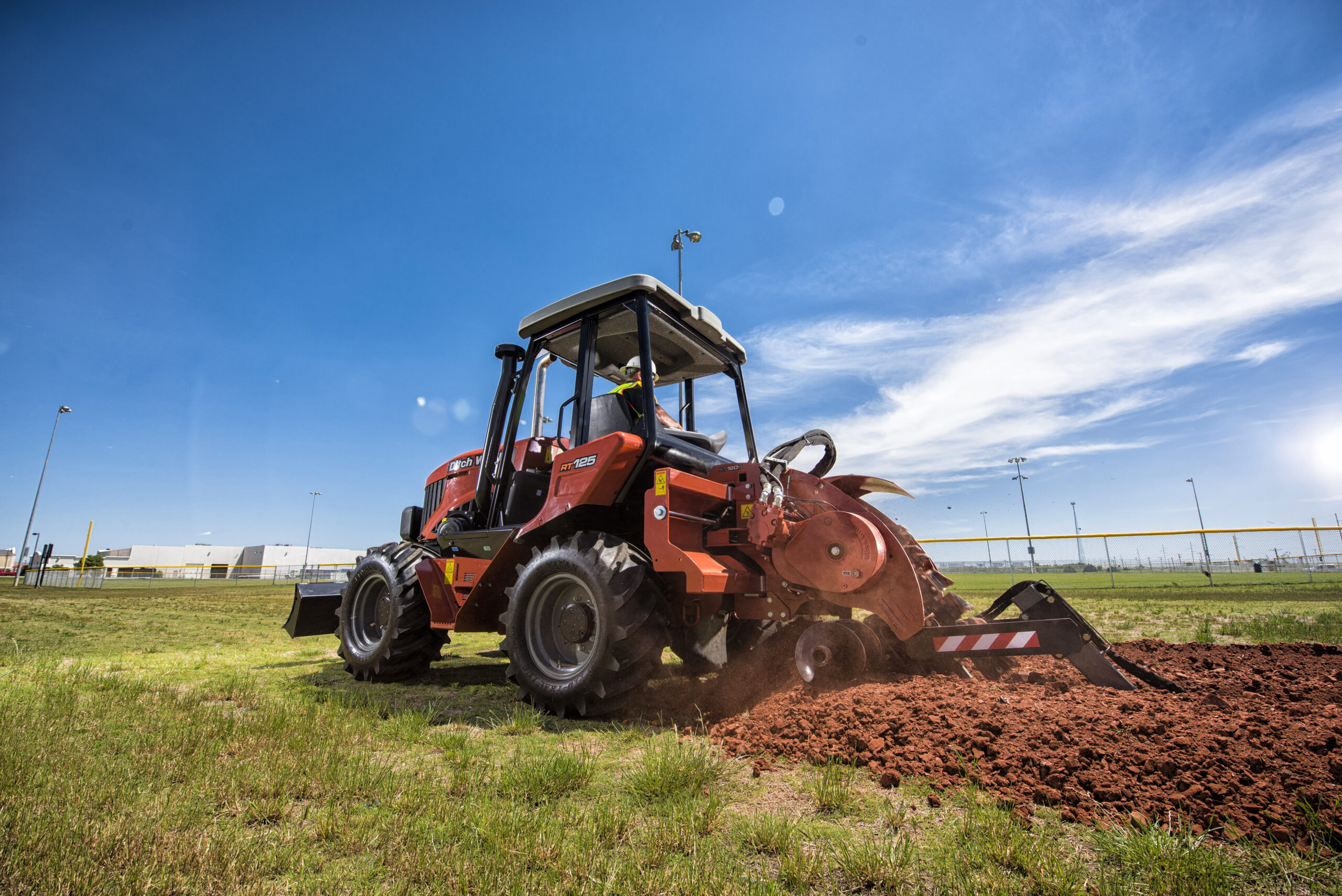
Ride-on trenchers are generally larger than walk-behind trenchers and are ones that are drivable.
This is a great choice if you don’t have any space constraints and are working on larger jobs. Ride-on trenchers allow you to create longer, deeper, and wider trenches faster than a walk-behind trencher. Take a look at our wide variety of Ditch Witch ride-on trenchers. This is also a great option if there is dense or rocky soil, as you will be able to dig most efficiently.
Walk-Behind Trenchers
Walk-behind trenchers are operated manually and are more labor-intensive. However, they’re great when you’re working with space constraints and want to make minimal damage to your terrain.
A walk-behind trencher is a less powerful trencher, but is good if you’re only going 2 to 3-feet deep, or only need a narrow trench. It’s easier to use if you’re working with more space constraints, as it’s generally more compact. Plus, walk-behind trenchers are generally more economical and affordable.
Walk-behind trenchers, though less powerful and robust, will also create less environmental disturbance. However, if you’re needing more horsepower to do the job, this type of trencher is going to be too lightweight for you. Take a look at our wide variety of Ditch Witch walk-behind trenchers.
Quad Trenchers
Quad trenchers are similar to ride-on trenchers in that they require a driver to operate them. Quad trenchers can use many types of different attachments, and with the correct attachments, can move material, place piping, or backfill soil. This is your most powerful type of trencher; quad trenchers have a lot of capacity and are very heavy-duty machinery. Be sure to check out our many different quad ride-on trenchers available at Ditch Witch West.
Microtrenchers
Microtrenchers can create trenches without damaging asphalt, and work on pavement. Most other trenchers are designed to work best on natural surfaces. These trenchers also cause minimal damage to the environment and can dig trenches up to 20 feet deep, though only a couple of inches wide. Be sure to take a look at the types of microtrenchers we offer here at Ditch Witch West.
Reach Out to Us
Our specialists can help pair you with the correct size and type of trencher to use for your project. Reach out to us with any questions you may have. We can’t wait to assist you!