


In Southern California’s High Desert, the ground can change its mind overnight. Heat tightens soil, wind strips the surface to dust, and colder nights loosen everything again. For crews drilling critical utilities, that unpredictability is what turns a “routine” bore into a high-stakes one.
Advantage Directional Drilling had built its reputation in that environment. Working across the High Desert and into Arizona, the team handles gas and fiber installs where precision is essential and bore data is documented. So when a bridge crossing near Deep Creek reached the final stretch and the locator signal disappeared, the job became a test of planning, experience, and support.
“This was one of those jobs where you don’t get a second chance,” said Johnny Torres, superintendent and driller for Advantage Directional Drilling. “We had to be exact.”
A Company Built on Repeatable Precision
Advantage began in 2004 when Torres’ father, Ralph, started drilling with a Ditch Witch JT520. Over time, the company’s edge came from consistency: disciplined habits, careful planning, and equipment they trusted when conditions were rough.
Crews stay intentionally lean, often just three people: an operator, a locator, and a third person training to cover both roles. “Everyone needs to understand the full process,” Torres explained. “That’s how you stay sharp.”
Advantage also exclusively runs Ditch Witch drills and Subsite locating systems. A JT30 has become a workhorse in their lineup, and Subsite tools, including newer options like the Marksman+, help them hold grade and produce the clean records California utility work requires.
A Relocation That Demanded a Smarter Plan
The Deep Creek project sounded simple: relocate a gas line about 25 feet to clear space for a new bridge footprint. But the bore had to pass beneath bridge infrastructure and through sugar sand, ground that can collapse if you push it too hard. The original plan called for two roughly 400-foot shots meeting in the middle. After depth calculations, Advantage realized the tie-in would require digging too deep in unstable sand. Instead, they committed to a continuous drill-and-pull operation: one long shot, start to finish.
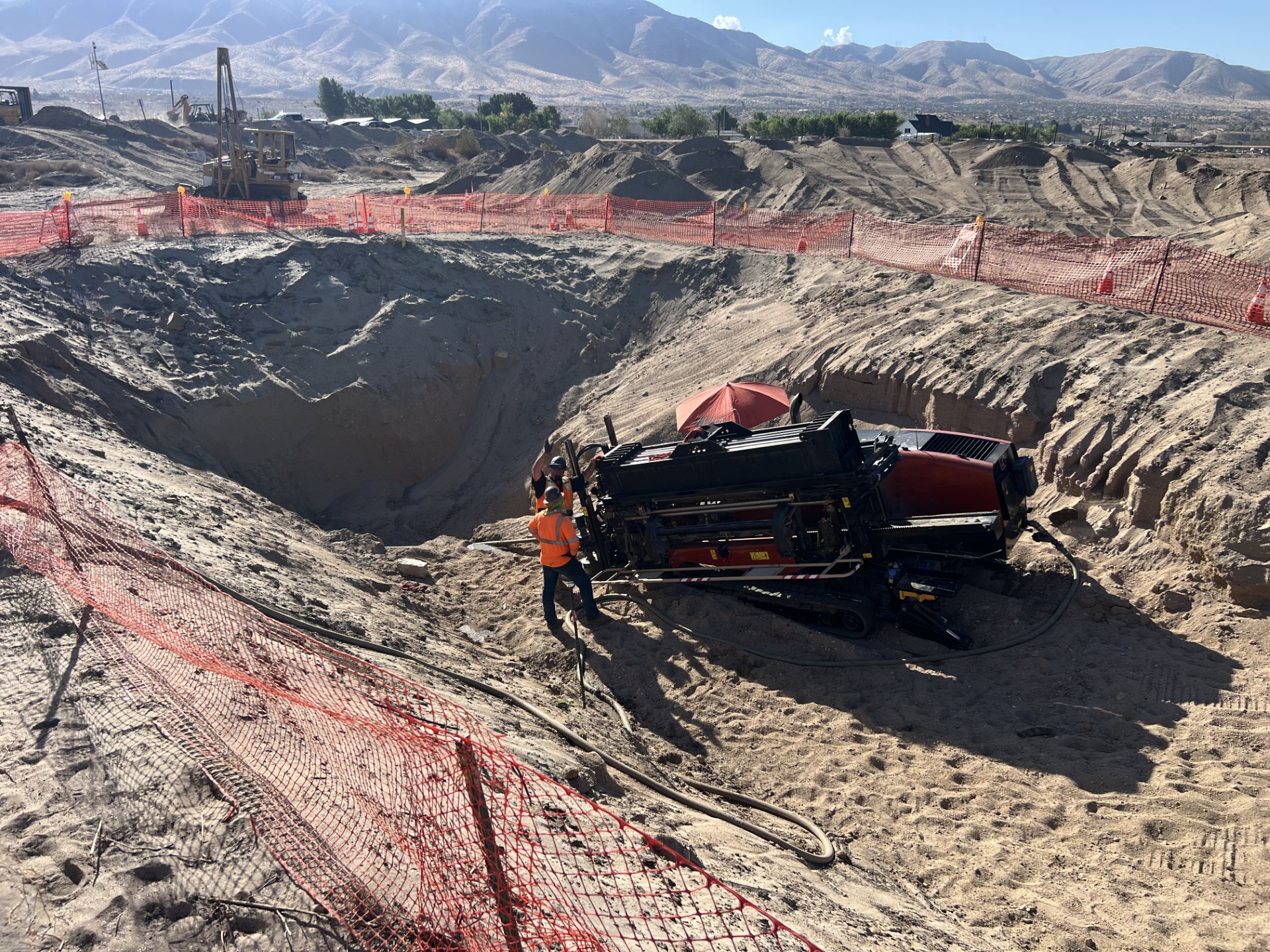
They excavated and shored an entry pit about 10 feet deep (roughly 10×10), then set a steady grade (around 2%) targeting close to 20 feet of depth beneath the bridge while keeping the line stable enough to pull eight-inch steel. “Once you start that run, there’s very little room to fix it later,” Torres said.
Planning the “What If” Before It Happened
Before the first rod went in, Torres asked his local Ditch Witch West Corona location to walk the bore with him. Dealer representative Andy Taminich reviewed the route and discussed likely interference zones and frequency options, especially for the final section near the bridge approach.
For the first 700 feet, everything went according to plan: the drill stayed on grade, readings were clear, and progress was steady. Then the bore reached the bridge.
Nearly 20 feet deep with roughly 100 feet left, the locator signal degraded and vanished. Pitch and angle became unreliable. Depth wasn’t something the crew could trust at a glance, exactly when accuracy mattered most.
Fixing the Problem Without Grinding to a Halt
Wireline locating was an option, but it would have slowed the project with scheduling and added steps. Torres called Ditch Witch West again. Taminich returned and worked alongside him while connecting with Subsite support. Together, they tested frequencies, knowing interference behaves differently depending on what’s overhead.
They cycled through multiple settings with limited success. After more adjustment, the signal began to return faintly. When they switched to 3.5, the locator stabilized enough to regain usable pitch and angle.
“That was the turning point,” Torres said. “Once we had pitch and angle back, we could keep moving.
Depth still required careful interpretation, so Torres leaned on grade calculations and controlled drilling. When the head finally surfaced, it emerged where it needed to: on target and according to plan.
After the crossing was complete, the interference finally made sense: the bridge structure wasn’t just typical rebar. It included heavy reinforcement (a dense grid of steel plus fiberglass-filled material) that scattered the locator signal.
Support That Kept the Schedule Alive
The full crossing took close to two weeks from the punch hole to pullback. Sugar sand slowed pre-reaming and demanded constant attention to stability. The crew used about 12 pallets of drilling fluid to protect the bore and support the pull. Midway through the job, Advantage also realized 600 feet of drill pipe wouldn’t be enough to finish an 800-foot run. Ditch Witch West coordinated an additional 300 feet of pipe and delivered it the same day, keeping the project moving instead of pausing for logistics.
In the High Desert, the ground will always try to rewrite your plan. What determines the outcome is how you respond: disciplined habits, proven equipment, and partners who show up when the signal goes quiet.
“I don’t take depth for granted,” Torres said. “Accuracy can save lives.”
Support from the Ditch Witch West team—especially the Corona location—played a key role in keeping this project moving when conditions became uncertain. From planning the bore to troubleshooting interference and coordinating critical equipment, having the right people involved made a measurable difference.
If you’re planning a complex bore or working through unpredictable ground conditions, connecting early with your local Ditch Witch West team can help you prepare, adapt, and stay on track when challenges arise.