



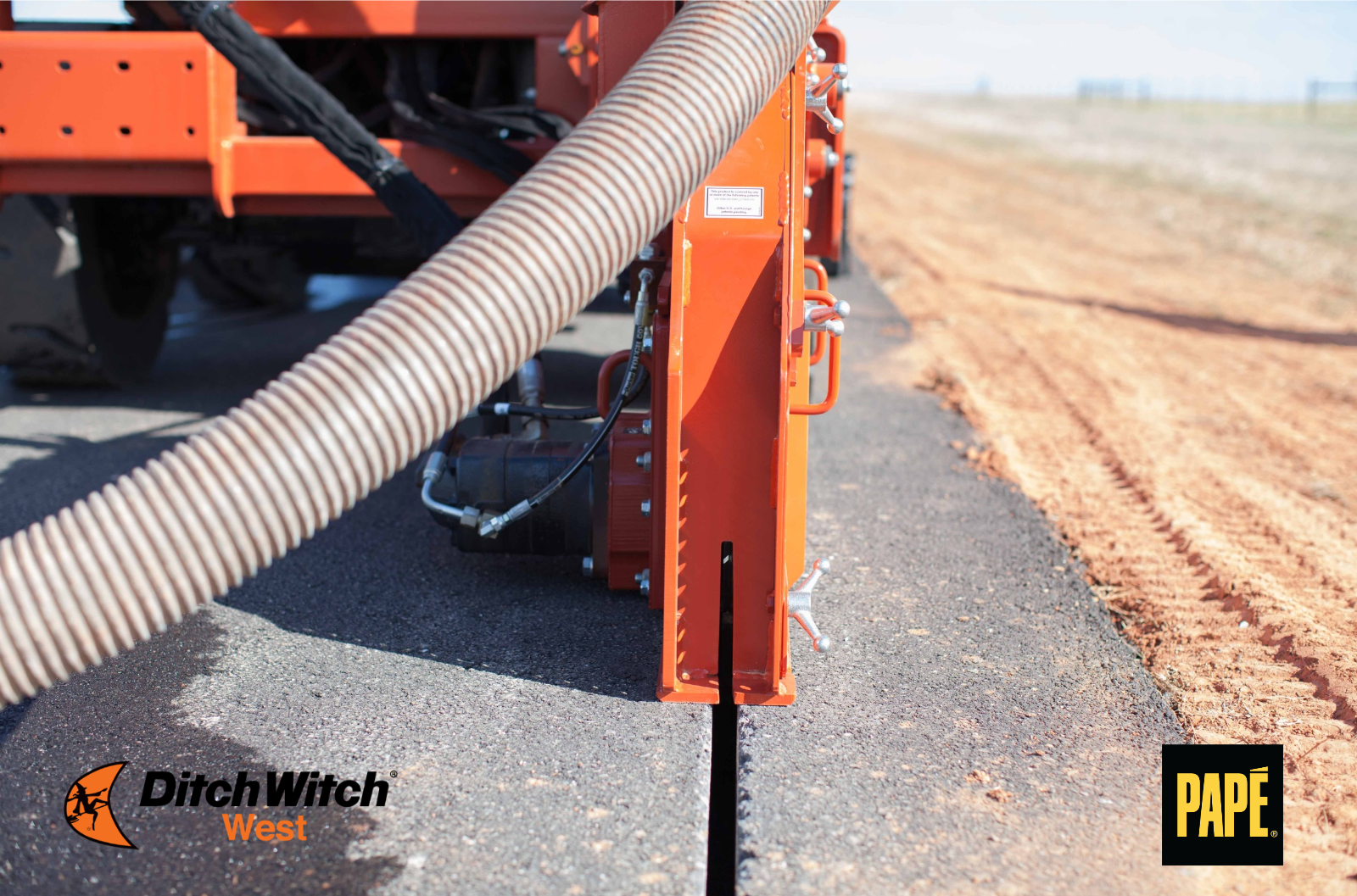
Choosing between microtrencher attachments should come down to more than maximum cutting depth. The right setup depends on the installation, pavement conditions, required trench dimensions, available working space, production targets, and the power unit supporting the attachment.
For crews working on fiber, utility, roadway, and other installation projects, the Ditch Witch MT16 and MT26 offer two different levels of microtrenching capability. Both are designed to produce clean, controlled cuts through asphalt or concrete, but their distinct characteristics make them better suited to different applications.
MT16: Compact Cutting for Shallower, Narrower Installations
The Ditch Witch MT16 is designed around precise, relatively narrow trenching. It can cut trenches up to 16 inches deep, with trench widths ranging from approximately 0.5 to 1.5 inches. Its 43-inch blade and compact configuration make the MT16 especially well suited for fiber-optic installation along paved rights-of-way. The narrower trench means less material to remove, less fill required during restoration, and generally less surface area to repair once the installation is complete.
Maneuverability is another advantage. The MT16 saw can articulate up to six degrees as it follows the machine path, helping operators negotiate street corners, cul-de-sacs, and other locations where a larger cutting system may be more cumbersome. The MT16 is also well suited for expansion-joint cutting, utility repair and maintenance, and other applications requiring a relatively narrow trench no deeper than 16 inches.
MT26: Greater Depth and Width for Larger Installations
When an installation requires greater depth or a wider trench, the MT26 offers increased cutting capacity.
The Ditch Witch MT26 Microtrencher can create trenches from 1.5 to 3 inches wide and up to 26 inches deep. Its 63-inch blade gives contractors substantially more cutting capacity than the MT16 while maintaining the controlled trench profile that makes microtrenching useful on paved jobsites. The additional depth can be valuable when project specifications, conduit packages, surface conditions, or utility-clearance requirements push the installation beyond the working range of the MT16. The wider cut can also accommodate applications requiring more space than a narrow fiber microtrench.
The MT26 includes saw swing, slide, lift, level, tilt, and trench-cleaning functions. Its hydraulic plunge provides variable depth control from zero to 26 inches, while hydraulic accumulators help maintain consistent down pressure on the cutting system. Those capabilities make the MT26 particularly attractive for longer production runs where a contractor needs greater trench capacity without moving to a traditional wide excavation.
Consider the Surface and Ground Conditions
Both MT16 and MT26 attachments are fundamentally designed to cut hard surfaces like asphalt and concrete. So choosing between them should start with the paved section of the project rather than soil conditions alone.
Blade selection depends on factors such as pavement composition, aggregate type, hardness, and abrasiveness. Both systems can use different cutting packages, including carbide-tipped blades and Ditch Witch PDC blades designed for demanding materials.
If most of the project takes place in open soil rather than pavement, a conventional trencher or vibratory plow may ultimately be more productive. Landscaping, irrigation, electrical, and general utility projects frequently involve a mix of surfaces, so evaluate whether microtrenching is required for the entire route or only for paved crossings and developed sections.
Evaluate Depth, Width, and Restoration Requirements
The most straightforward dividing line between the MT16 and MT26 is trench geometry.
For narrower installations requiring no more than approximately 16 inches of depth, the MT16 minimizes the amount of pavement being removed. That can translate directly into less spoil, lower backfill requirements, and reduced restoration work.
When specifications call for deeper placement or a trench wider than the MT16 can provide, the MT26’s 26-inch maximum depth and 1.5- to 3-inch cutting range provide substantially more flexibility.
The objective should not automatically be to select the attachment with the greatest capacity. Cutting deeper or wider than necessary increases material removal and restoration quantities. The most efficient setup is generally the smallest trench profile that safely and reliably meets installation specifications.
Account for Jobsite Access and Equipment Compatibility
Physical size also matters. The MT16 weighs approximately 2,015 pounds, compared with approximately 3,567 pounds for the MT26. The MT26’s larger blade and attachment structure consequently require more consideration for maneuvering, transportation, and working clearance.
For tighter paved corridors, residential streets, and routes with frequent direction changes, the MT16’s smaller footprint can be an advantage. On projects where access is less restrictive and greater cutting capacity is the priority, the MT26 can deliver the depth and trench size needed for more demanding installations.
Carrier compatibility should also be confirmed before selecting an attachment. Ditch Witch West identifies the MT16 as part of a microtrenching system configured around the RT80 ride-on trencher, while the MT26 is designed as part of a system incorporating the RT80 and can be paired with vacuum excavation equipment for spoil management.
Choose the Attachment Around the Installation
Neither attachment is universally better. The MT16 is an efficient choice when you need a narrow, precise cut, shallower installation depth, and greater maneuverability. However, the MT26 gives you increased depth and width for jobs that demand greater cutting capacity.
The key is matching the machine to the trench specification, surface conditions, access constraints, carrier, and expected production rate.
Contact your local Ditch Witch West team to compare microtrenching equipment and determine which attachment best matches your upcoming utility, fiber, irrigation, landscaping, or infrastructure project. Choosing the right configuration from the start can help reduce unnecessary excavation, control restoration costs, and keep production moving.